
Compiles studies on exploratory therapies, emphasizing client reports.
Pela, C., & Sutton, P. M. (2021). Sexual attraction fluidity and well-being in men: A therapeutic outcome study. Journal of Human Sexuality, 12, 61–86. https://www.reintegrativetherapy.com/wp-content/uploads/2024/11/JHS-PelaSutton.pdf
Summary: Documents reductions in same-sex attraction and well-being improvements in 40 men over 2+ years of SAFE therapy.
Common misrepresentation: Rejected as lacking controls or proving common/permanent change.
What it actually shows: Some clients report fluidity shifts and reduced distress via value-aligned exploration, without guarantees for all.
Nicolosi, J. J., Jr., & Szandula, J. (2024). Memory reconsolidation for unwanted sexually arousing memories: A randomized, placebo-controlled study. Integratus, 2(4), 287–305. https://doi.org/10.1521/intg.2024.2.4.287
Summary: RCT shows memory reconsolidation reduces arousal to unwanted same-sex stimuli comparably to heterosexual ones.
Common misrepresentation: Claimed to prove full orientation change ignoring dropouts.
What it actually shows: Potential to explore reducing specific unwanted arousals, supporting fluidity investigation without broad change promises.
Sullins, D. P., & Rosik, C. H. (2025). Perceived effectiveness and risk of sexual orientation change efforts (SOCE): Perspectives of a US sample of 125 male clients. Journal of Open Inquiry in the Behavioral Sciences, 4(4). https://doi.org/10.58408/issn.2992-9253.2025.04.04.0001
Summary: Retrospective survey of 125 men reporting that SOCE was associated with moderate reductions in unwanted same‑sex sexuality and more frequent marked psychosocial benefits than harms, though results rely on self‑report and a convenience sample.
Common misrepresentation: Cited as definitive proof that SOCE is broadly safe and effective for all clients, or that orientation can be reliably “changed” on demand.
What it actually shows: One self‑selected male sample in which many participants perceived some reduction in unwanted same‑sex sexuality and net psychosocial improvement, supporting the possibility of beneficial exploratory or change‑allowing therapy for some, without demonstrating universal efficacy or safety.
Rosik, C. H. (2023). A wake‑up call for the field of sexual orientation change efforts research: Comment on Sullins (2022). Archives of Sexual Behavior, 52, 869–873. https://doi.org/10.1007/s10508-022-02481-7
Summary: Methodological and interpretive critique arguing that much SOCE‑harm research inadequately handles timing, sampling, and confounds, and that Sullins’s reanalysis of suicidality data deserves a more balanced reception.
Common misrepresentation: Portrayed as denying any risk from SOCE or dismissing all reports of harm as fabricated or irrelevant.
What it actually shows: A call for more rigorous and even‑handed SOCE research that neither assumes harm nor safety in advance, while highlighting evidence compatible with some clients exploring fluidity in therapy under careful methodological scrutiny.
Rosik, C. H., Lefevor, G. T., & Beckstead, A. L. (2023). Sexual minorities responding to sexual orientation distress: Examining 33 methods and the effects of sexual identity labeling and theological viewpoint. Spirituality in Clinical Practice, 10(3), 245–260. https://doi.org/10.1037/scp0000295
Summary: Survey of sexual minorities showing that people use a wide range of 33 strategies—including same sex affirming, neutral, and change‑allowing approaches—to cope with sexual‑orientation distress, and that outcomes vary with sexual identity labels and theological views.
Common misrepresentation: Simplified as proving that change-oriented methods are either uniquely harmful or uniquely successful, ignoring the broader mix of strategies and contextual moderators.
What it actually shows: Evidence that clients’ coping strategies and choices around sexual‑orientation distress are diverse and shaped by worldview, supporting value‑consistent exploratory work (including but not limited to change‑allowing therapy) without asserting that any single pathway is universally best.
Rosik et al (2023) Tables of Helpfulness and Harmfulness of 33 Methods Addressing Sexual Orientation Distress
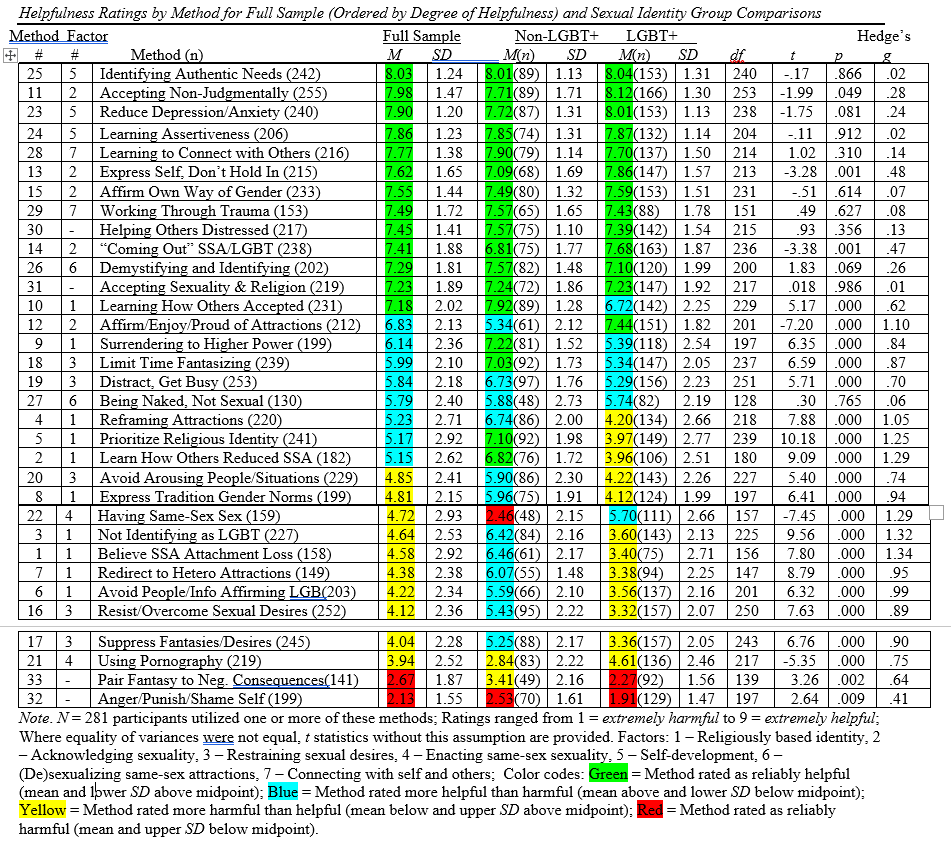
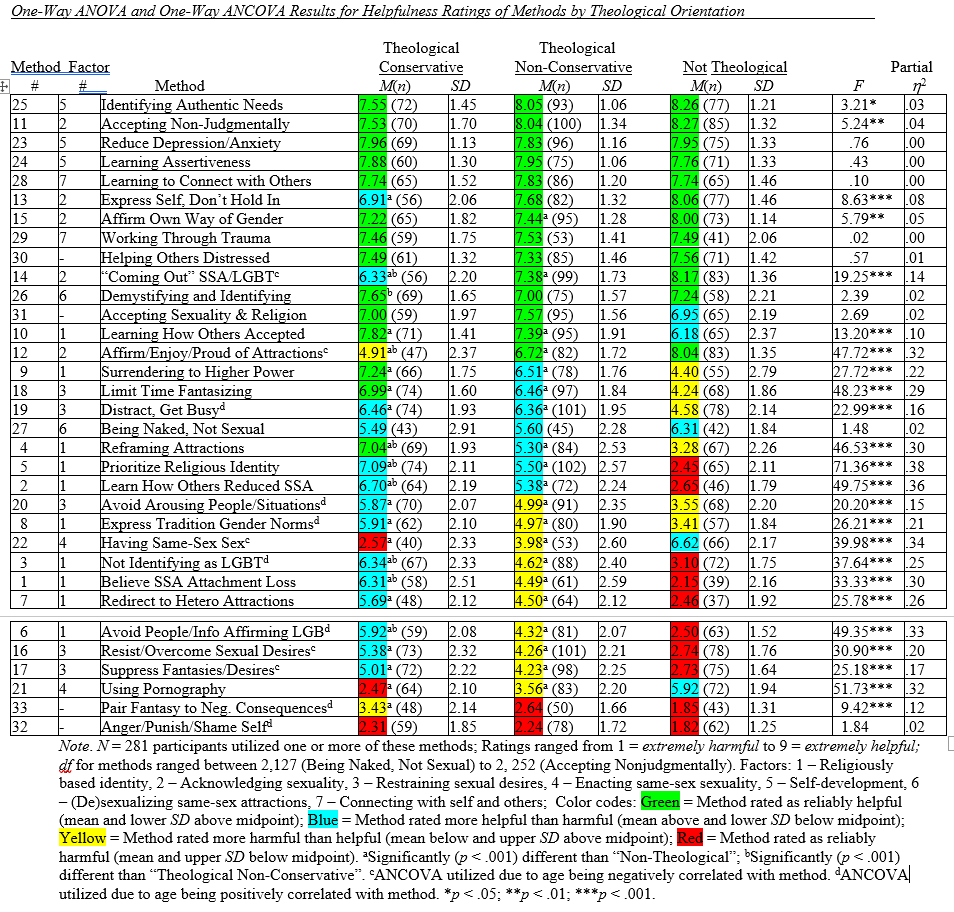
FROM: Rosik, C. H., Lefevor, G. T., & Beckstead, A. L. (2023). Sexual minorities responding to sexual orientation distress: Examining 33 methods and the effects of sexual identity labeling and theological viewpoint. Spirituality in Clinical Practice, 10(3), 245–260. https://doi.org/10.1037/scp0000295
Supplemental materials: https://doi.org/10.1037/scp0000295.supp